The conversation around artificial intelligence in healthcare continues to focus heavily on technology.
Large language models. Agents. Reasoning engines. Increasingly sophisticated conversational interfaces.
But for Medicare insurance professionals, the opportunity is considerably more practical:
How can AI help agents make better-informed recommendations, serve beneficiaries more effectively, and navigate increasingly complex coverage decisions?
Consider an agent preparing for a client appointment during the Annual Enrollment Period. A longtime beneficiary wants to know whether her cardiologist will remain in-network next year, whether her prescriptions will still be covered, and whether changing plans might reduce her healthcare expenses.
For Medicare Advantage, answering these questions requires examining provider networks, prescription formularies, pharmacy relationships, benefits, and coverage restrictions. Original Medicare, including when paired with Medigap, generally does not impose the same plan-specific provider-network restrictions. [1]
The agent's challenge is not merely finding information. It is interpreting multiple sources, identifying meaningful differences, and translating those differences into recommendations the beneficiary can understand.
At Livmor.ai, we believe this is where artificial intelligence can make a meaningful difference: equipping Medicare professionals with better information, more effective analytical capabilities, and the ability to deliver personalized guidance with greater confidence.
Achieving that requires considerably more than attaching a chatbot to a collection of healthcare documents.
From Information Access to Decision Intelligence
Medicare technology has traditionally approached information delivery through search, filtering, and comparison.
Medicare.gov's Medicare Plan Finder provides beneficiaries with access to plan benefits, drug coverage, and estimated costs. These capabilities are valuable, but even when comprehensive information is available, the burden of interpreting its implications frequently remains with the beneficiary or their agent. [2]
A plan with a lower premium may generate higher prescription expenses. A preferred physician may participate in one Medicare Advantage network but not another. Two plans covering the same medication may apply different cost-sharing arrangements or utilization restrictions.
For agencies managing hundreds or thousands of beneficiary relationships, these challenges multiply. Understanding what has changed, identifying clients who need attention, and preparing meaningful recommendations can become a substantial operational burden.
This is where decision intelligence becomes important.
Beyond retrieving relevant facts, an intelligent platform can examine how those facts relate to individual circumstances, identify meaningful tradeoffs, and help agents determine what deserves further attention.
For Medicare professionals, that means spending less time assembling information and more time exercising judgment and serving clients.
The Foundation: Trustworthy Data Before Intelligent Answers
In our previous articles, we explored two challenges underlying Livmor's Medicare intelligence platform.
The first was acquiring reliable information from a fragmented ecosystem of CMS publications, carriers, provider directories, pharmacy networks, and other sources. The second was transforming that information into a consistent, governed foundation through normalization, validation, curation, and provenance tracking.
These investments directly influence what an intelligent healthcare experience can reliably deliver.
Consider a familiar question: "Will my cardiologist still be in-network next year?"
Answering accurately requires identifying the correct physician, resolving practice locations, matching the appropriate plan and network, and evaluating information that may have changed since publication.
The risks associated with inaccurate directories are well documented.
In CMS's third round of Medicare Advantage provider-directory reviews, reported in November 2018, the agency examined 5,602 providers across 10,504 practice locations from 52 Medicare Advantage organizations. The sample included cardiologists, primary care physicians, oncologists, and ophthalmologists.
CMS found inaccuracies in 48.74% of the sampled locations. [3]
These are historical findings, not an estimate of today's error rate. They nevertheless demonstrate why published provider information must be approached with appropriate validation.
Regulatory efforts continue to address the issue. Current Medicare Advantage rules require online provider directories to be updated within 30 days after receiving information requiring a change. Section 422.111(m) also requires plans to make specified directory information available to CMS, update it within 30 days of becoming aware of changes, and attest to its accuracy at least annually. Although the latter provision applies beginning with the 2026 plan year, CMS's operational integration of plan-supplied directory data into Medicare Plan Finder has proceeded in phases, including implementation for 2027. [4, 5]
In October 2026, CMS proposed further requirements under Section 6220 of the Consolidated Appropriations Act of 2026, the REAL Health Providers Act. These address periodic directory verification, accuracy reporting, and protections for beneficiaries who rely on inaccurate information. The proposed requirements begin in contract year 2028, with public accuracy-score reporting contemplated for 2029. They are not changes taking effect for the current 2027 enrollment cycle. [6]
For AI-enabled Medicare platforms, the implication is clear: sophisticated reasoning cannot compensate for incomplete or inaccurate underlying information.
The reliability of an answer ultimately depends on the quality of its supporting evidence.
Beyond the Chatbot: AI Grounded in Healthcare Context
Conversational AI has fundamentally changed expectations about how people interact with technology.
Instead of navigating complicated interfaces, users increasingly expect to express what they need in ordinary language.
This is especially relevant to Medicare, where terminology and benefit structures can be difficult to interpret. Beneficiaries think about physicians, medications, affordability, and continuity of care, not formulary tiers, network identifiers, or utilization-management rules.
Medicare agents bridge that gap every day.
At Livmor, we're building that experience through LivmorIQ, our Medicare agent platform, and AskErin, its conversational AI copilot.
LivmorIQ brings together plan research, beneficiary management, plan analysis, and agent workflows. AskErin provides natural-language assistance within that environment.
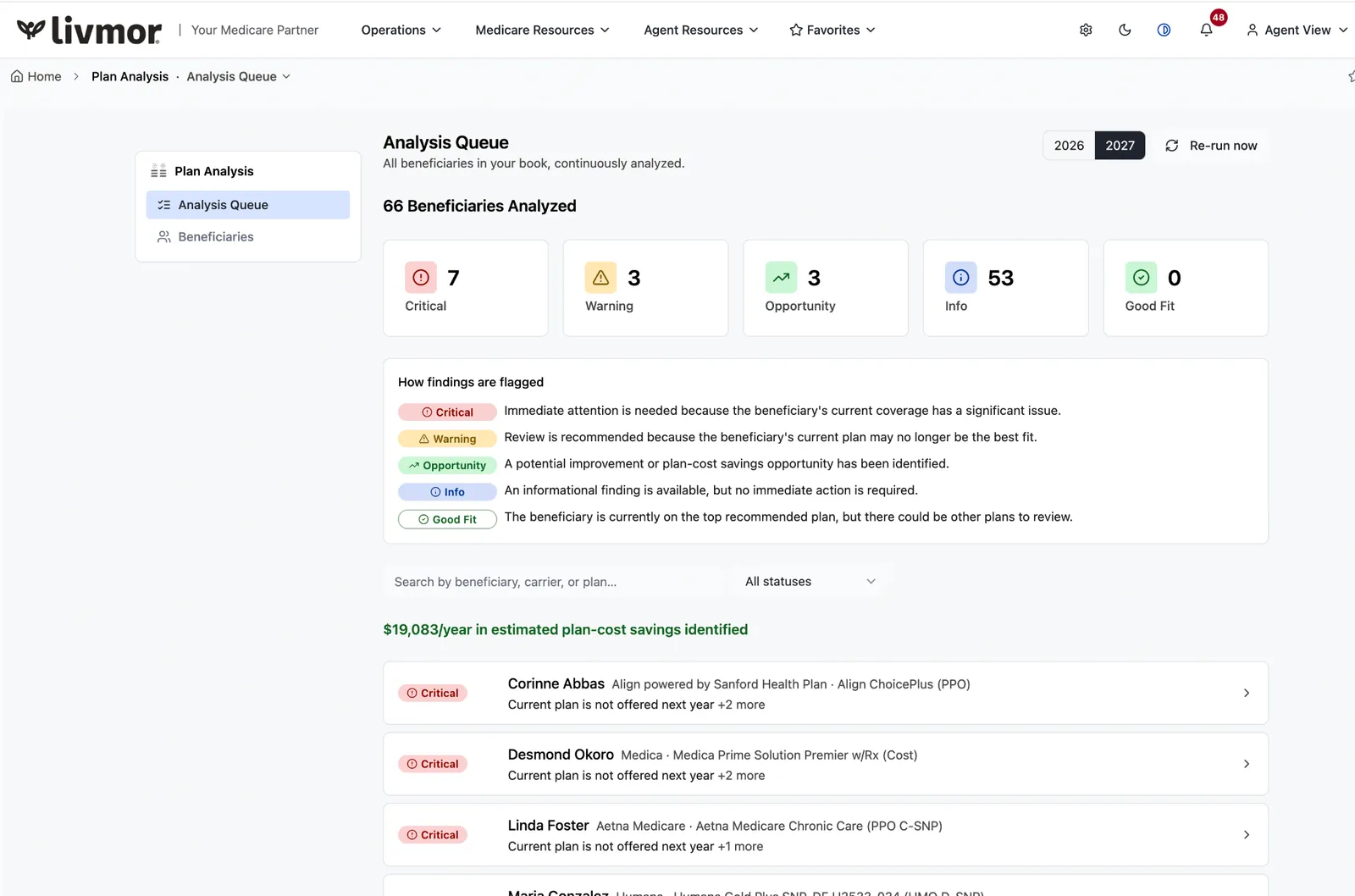
Our current publicly described capabilities include plan comparison, Scope of Appointment management, beneficiary workflows, and Plan Analysis, which reviews client coverage and presents findings in a prioritized queue. [7]
These are practical applications of the underlying architecture rather than speculative AI demonstrations.
The next architectural opportunity extends beyond individual searches toward coordinated analysis across providers, prescriptions, benefits, and financial considerations.
Those more advanced capabilities represent the direction of the platform, rather than a claim that every scenario is already fully automated.
From Individual Questions to Meaningful Comparisons
Imagine an agent evaluating two Medicare Advantage plans for a client who sees a cardiologist several times each year, takes four prescriptions, and prefers a particular pharmacy.
A conventional comparison might display premiums, deductibles, copayments, and benefit summaries.
An intelligent experience should help the agent understand how provider continuity, prescription coverage, utilization restrictions, and financial exposure interact.
Consider a provider discrepancy
Suppose Plan A lists the client's cardiologist as participating at a particular location, while another source suggests the physician's network affiliation may have changed.
The discrepancy could reflect outdated information, differences in effective dates, or participation at one practice location but not another.
Simply selecting the newest record could produce an incorrect conclusion.
A more capable system should recognize the disagreement, evaluate the supporting evidence, and determine whether additional verification is required.
An illustrative agent-facing response might be:
"Plan A lists this client's cardiologist as participating at the selected location, but another source indicates a possible network change. Confirm participation with the carrier and physician's office before making an enrollment recommendation."
This example illustrates the type of evidence-aware reasoning we're working toward, not a claim of an existing fully automated feature.
It also demonstrates why the provenance capabilities discussed in our earlier article matter. When information can be traced to its original source, acquisition date, applicable plan year, and governed transformations, discrepancies can be investigated rather than silently ignored.
The ability to explain uncertainty is as important as the ability to provide an answer.
Financial analysis deserves the same rigor
Prescription drug coverage provides another example.
Under Medicare Part D, qualifying annual out-of-pocket prescription drug spending is limited to $2,400 for 2027, compared with $2,100 in 2026. The Medicare Prescription Payment Plan also allows beneficiaries to spread eligible prescription expenses into monthly payments, improving cash flow without reducing total drug costs. [8]
These provisions affect how agents should evaluate total annual expenses versus monthly affordability.
A meaningful comparison must also consider premiums, formulary restrictions, pharmacy pricing, and anticipated prescription utilization.
For an agent, the opportunity is to understand how these variables interact and explain why one coverage option may be more appropriate for a particular beneficiary.
Intelligent Assistance Within Responsible Boundaries
Agentic AI offers the potential to coordinate several specialized operations (provider lookup, prescription analysis, plan comparison, and financial calculations) into a coherent workflow.
But increased automation also introduces additional responsibilities.
Medicare Advantage and Part D marketing activities operate under federal requirements governing beneficiary contact, agent conduct, and Scope of Appointment documentation. These requirements continue to apply when agents use AI-assisted platforms. [9]
An analytical finding should never be interpreted as blanket authorization to contact a beneficiary through any channel or initiate a marketing activity. The nature of the client relationship, applicable contact restrictions, permissions, and communication method all matter.
AI can help prepare information and organize workflows, but appropriately authorized professionals remain responsible for their advice, communications, and enrollment activities.
Privacy introduces similar responsibilities. Personalized analysis may involve sensitive beneficiary information, requiring appropriate access controls, authorization, data minimization, and safeguards under HIPAA where applicable.
At Livmor, we see these considerations as integral to the architecture supporting intelligent Medicare experiences.
The Strategic Opportunity: From Transactions to Ongoing Intelligence
Medicare is often approached as an annual enrollment activity.
As of October 2026, beneficiaries are in the Annual Enrollment Period, running from October 15 through December 7, during which they can make coverage changes for 2027. Beneficiaries already enrolled in Medicare Advantage may also have more limited opportunities during the Medicare Advantage Open Enrollment Period from January 1 through March 31. [10]
But healthcare needs do not operate on an annual schedule.
Prescriptions change. Physicians join or leave networks. Coverage rules evolve. Financial circumstances and individual priorities shift.
For Medicare agents, this creates an opportunity to move beyond episodic plan selection toward a more continuous client-service relationship.
LivmorIQ's Plan Analysis capability reflects this direction.
The platform analyzes beneficiary coverage against known needs and organizes findings into an Analysis Queue. Critical findings may identify uncovered medications or plans ending; warnings can surface possible coverage concerns; opportunities can highlight potential savings; and informational findings can identify items worth reviewing. [7]
That prioritization helps an agent determine which client relationships may deserve attention and why.
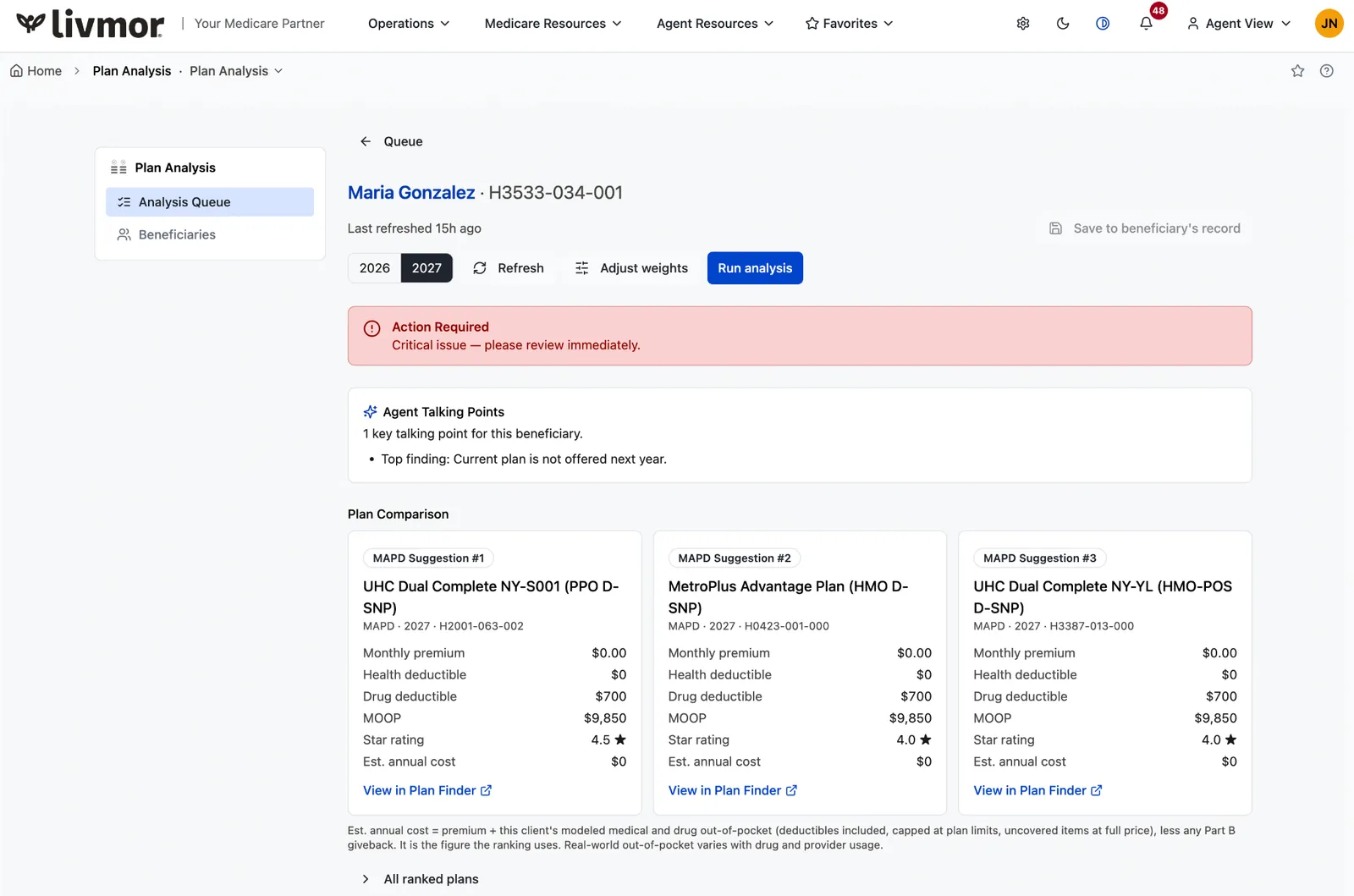
Any subsequent outreach must still comply with applicable Medicare marketing and communication requirements. Internal analysis and authorized client contact are separate activities, and the platform's workflows must respect that distinction.
The larger opportunity is to make Medicare agencies more proactive, helping them identify relevant changes earlier and support beneficiaries throughout the year.
The Strategic Reality
Healthcare AI continues to be evaluated heavily through the capabilities of its underlying models.
Yet as conversational interfaces and general-purpose reasoning become increasingly accessible, they will become less meaningful differentiators on their own.
More durable value will come from the surrounding systems: reliable domain information, specialized analytical capabilities, effective governance, and product experiences designed around real professional workflows.
For Livmor, this connects the architectural investments described in our previous articles directly to LivmorIQ.
Our acquisition architecture brings fragmented Medicare information together. Normalization and curation create a consistent, traceable foundation. LivmorIQ turns that information into useful agent workflows, while AskErin makes complex information more accessible through conversation.
For agents, the objective is less time researching and assembling information and more time applying professional judgment.
For beneficiaries, it is greater clarity and better-informed healthcare coverage decisions.
Final Thought
For years, healthcare technology has concentrated on making more information available.
AI now creates an opportunity to turn that information into understanding and informed action.
But success will depend on the integrity of the data, the discipline of the architecture, and the responsibility with which intelligence is applied.
At Livmor.ai, we're bringing those capabilities together to help Medicare professionals navigate complexity, strengthen client relationships, and deliver more informed guidance.
That's the promise of moving from trusted data to intelligent decisions.
References
- Medicare.gov, Compare Original Medicare & Medicare Advantage. Provider access, network restrictions, and coverage differences. medicare.gov
- Medicare.gov, Medicare Plan Finder. Official Medicare health and prescription drug plan comparison tool. medicare.gov
- CMS, Online Provider Directory Review Report, Round 3 (November 2018). Historical study of Medicare Advantage provider-directory accuracy across 52 organizations. cms.gov
- 42 CFR § 422.111(m) and § 422.2267(e)(11). Current Medicare Advantage provider-directory data submission, updating, attestation, and publication requirements. ecfr.gov section-422.111ecfr.gov section-422.2267
- CMS, Medicare Plan Finder Provider Directory Implementation: Office Hours Q&A (September 2026). Guidance explaining implementation, validation, and ongoing directory updates for contract year 2027. cms.gov
- CMS, Medicare Program; Implementation of Sections 6219, 6220, and 6224 of the Consolidated Appropriations Act, 2026 (October 16, 2026). Proposed rule; Section 6220 addresses Medicare Advantage provider-directory accuracy and reporting. cms.gov
- Livmor.ai, LivmorIQ Medicare Agent Platform. Product descriptions for Plan Analysis, AskErin, plan research, beneficiary management, and agent workflows. livmor.ai/platform
- Medicare.gov, Part D Costs and Medicare Prescription Payment Plan. Annual out-of-pocket thresholds and prescription payment options. medicare.gov costsmedicare.gov prescription-payment-plan
- 42 CFR §§ 422.2264 and 423.2264. Medicare Advantage and Part D beneficiary-contact and personal marketing appointment requirements. ecfr.gov section-422.2264ecfr.gov section-423.2264
- Medicare.gov, Medicare Enrollment Periods. Annual Enrollment, Medicare Advantage Open Enrollment, and other enrollment opportunities. medicare.gov